Friday, February 14, 2014

Who was JClement

“The people who have left us are never truly gone until there is no one left to remember them.”      Unknown Author

In Colrain, Massachusetts off of Ed Clark Road is a small cemetery known as Christian Hill. Just inside the gate on the right side is a small field stone, roughly cut. Hand carved letters on the face of the stone spell out JClement; there are no other Clements in this small cemetery. There is nothing on the stone that identify this person other than a name.

Let me tell you a little about her; she was born Mary Jane Palmer on April 14, 1845 in Leray, Jefferson Co., New York. Her parents were Lorenzo Palmer and Pamelia Merritt and the family farmed land in what is now Fort Drum New York. 

On March 10,1866 she married Daniel L. Clement, a recently returned Civil War solder who served with the 42nd NY Infantry Regiment.  Daniel joined the Army at 16 years old to fight for his country, and was discharged on June 30, 1865. 

Daniel and Jennie, as she was known all her life, had 6 children; Mattie, Charles, George, Anna, Samuel and Edwin.  They farmed land in North Wilna, New York during their lives together.   Charles and George died very young, Anna died at age 20 of complications of child birth, and her remaining 3 children lived long and productive lives. 

In 1894 Daniel, at the age of 47, died of Brights Disease, Mattie was married and by 1896 was living with her family in Colrain, MA. That left Sam and Edwin who were living with her and farming the land in New York. 

Jennie moved to Colrain just before the turn of the century and began a farm with her two sons and her brother James. 

Around 1905 she returned to New York with her son Edwin; Sam decided to stay behind as he had met Emma Farnum, a weaver who worked at a Colrain Textile mill.  They would be married in later 1905. 

She returned to Massachusetts around 1910, living with her daughter, for a time. Whether it was home sickness or knowing that the end was near, she wanted to return home to New York.  While arraignments were being made with Edwin to get her back home, she died suddenly and was buried in the small  Christian Hill Cemetery, on top of the hill. 

Certainly more could and should be said of a life that lasted 67 years but at least our Great Gandmother is not forgotten

**The image of Jennie Palmer Clement is a pencil and charcoal drawing that her grand son John Edwin Clement Sr.  identified as her several years ago.


Access Jennie Clement's  Find A Grave Memorial  at this link


Sunday, November 10, 2013

Charles B. Clement


What does the Erie Canal and the Clement Family have in common?

Well first let’s start with a bit of US History.  The Erie Canal was proposed in 1808 and completed in 1825; it connects Lake Erie in western New York state to the Hudson River.   In those days the most efficient trade routes were managed in waterways.  There was no direct route from West to East, and any goods that needed to travel either way were tied to pack animals and transported by foot.  A pack animal could handle about 250 pounds of goods, which was no where near what was necessary to build up New York State for settlement. The important part of connecting Erie to the Hudson River was that products could be shipped up river from New York City or down from the St Lawrence Sea Way, and then distributed across the state via this system of Canals and Locks.    More information about the Canal and it’s importance to New York and the Country can be found at  http://en.wikipedia.org/wiki/Erie_Canal


Now on to Charles B. Clement who was born February 15, 1818 in Salina, Onondaga Co., New York.  Much of what I know about Charles comes from his family bible and records that I’ve been able to locate through research.   Charles is the last positive link in our family chain that I have primary sources evidence for, meaning there are original records that document his life.  Some of the information I am going to give you will be theory and I will identify that from facts.    Research has not identified Charles’ father, mother, or siblings at the present time, but it can be inferred that they were residents of Salina NY and Onondaga County.  Around 1844 he met Sarah A. Bromley, who was born May 6, 1821 in New Haven, Oswego Co., New York, and they married August 12, 1844 and began their family.  

Their first child, Annie M. was born June 1,1845 in Scruple, Oswego Co., New York.  In 1869 she married John V. Harris.  Not many records have been found to this point that identify what happened to the Harris family,  that is still a work in progress.  As is the youngest son Ira Franklin, born November 28, 1848 in Lysander, Onondaga Co., NY;  almost nothing is available on him other than I know he was alive and six years old in 1855.  At present that is the last mention of him in the official record that I’ve found.   

Charles and Sarah’s second child Daniel was born May 8, 1847 in Philadelphia, Jefferson Co., New York, and more about him can be found in the previous post. 

By 1850, Charles, Sarah and all of the children had settled in Lysander, Onondaga Co., NY and he was identified in the census of that year as a boatman.  Because earlier census reports only identify the head of house by name, there is no way to tell based on those documents, what Charles may have been doing before that.  However, it would not be too much of a stretch or surprise to find that he may have followed in his father’s foot steps. 

The records indicate that in 1870 Charles, without his family, was in Jefferson Co., New York and was in the household of Ira Clement, whom I believe to be his brother.  The census of that year indicated that he was 57 years old and a farmer.  So it appears that he went to Jefferson County to obtain work, as it wasn’t uncommon in the day to have the husband travel great distances to find work while the wife stayed home; then if steady work was found, he would send for the rest of the family to join him.   In Charles’ case, he did not stay in Jefferson County but returned home and began farming himself.  By 1875 he had established himself as a farmer, his wife, daughter and her husband John Harris (who was by this time a sailor) lived with him.   Daniel was in Jefferson County himself establishing his family and there is no indication where Ira Franklin was or if he survived into adulthood. 

In 1880 Charles and Sarah left Onondaga County and settled in Brownville, Jefferson Co., New York; their neighbor was William B. Clement, son of Ira.  They stayed in this area until Sarah died on April 3, 1890, at the age of 69.  

On July 3, 1897 Charles entered into the Jefferson County Poorhouse at the age of 79 years old.  These places treated the residents as inmates, they lived in dorms with sometimes 15 or more people to a room. If your wife came with you, they separated you at night.  The Keeper of the Poorhouse decided everything for the "inmates"  from meals to when people could receive medical treatment, there were no bathing facilities and while it was heated in the winter, there was nothing to cool or circulate the air in the summer.  Not a great situation to end up in after a full life of working and with no social safety net; if you had no money, the choice was the poorhouse or freezing to death.  He probably did not survive long in this place, and he is not listed in the census of 1900.

I believe that Charles B. Clement died between 1897 and 1900, but he had no known grave marker, nor do I know where he is buried.  I have to assume somewhere on the grounds.

Grandfather Charles may be lost to us, but he is not forgotten!


“The people who have left us are never truly gone until there is no one left to remember them.” 


Sunday, November 3, 2013

Who was Daniel L. Clement

Who was Daniel L. Clement
citizen soldier, farmer and our great great grandfather

Daniel was born 8 May 1847 in Philadelphia, Jefferson, Co., New York to Charles and Sarah Bromley Clement.  He had two siblings; Annie M., born 1 June 1845, and Ira Franklyn, born 28 November 1848. The family was engaged in farming as their primary trade.  They appear to have travelled quite a bit judging from the places where the children were born.  

When Daniel was 16 years old he went to New York City to enlist in the Army.  He entered service August 31 1863 and was mustered into the 42nd New York Volunteer Infantry Regiment; he stayed in that unit until June 28, 1864, when he was transferred to the 82nd NY Infantry Regiment.  On July 10, 1864 he was transferred again to the 59th  New York Infantry, where he stayed until he left the service when the Regiment was disbanded at Munsons Hill, VA on June 30, 1865.   
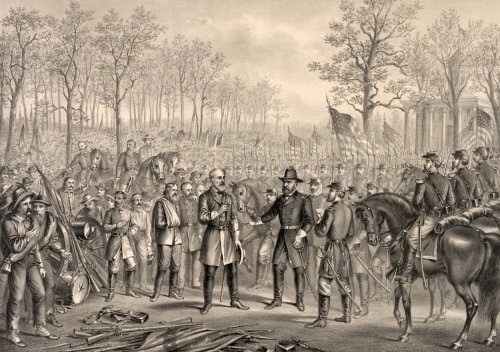
During his time in service he was present at the battles of Spotsyvannia Court House, Cold Harbor, Petersburg, Appomattox, White Oaks and Appomattox Court House.  His unit was present at the surrender of Robert E. Lee and since his service record does not mention he ever missed a day of service, one must conclude that he was there when the surrender occurred.  His unit returned to Washington DC. for the Grand Review on May 23, 1865 and for the mustering out on June 30. 

When he left service his discharge papers noted the following; Daniel Clement, 18 Years old, entered service 31 August 1863 to serve 3 years and was discharged 30 June 1865 at Munsons Hill, VA due to the “Expiration of the War.”  The discharge also indicated that he was 5’2” tall, with a light complexion, with brown hair and blue eyes.  His discharge order was signed by William Olstead; Colonel  59th New York Regiment.

Daniel returned home, and on March 10, 1866, two days after his 19th birthday, married Mary Jane (Jennie) Palmer.  They had 6 children; Mattie, Charles, George, Anna, Samuel, and Ira Edwin.  (See Post Who is J Clement.) With the children, they began farming in  Lewis Co., New York.   Charles and George were both lost early on.  Mattie married and moved to Colrain MA with her husband, Albert Herzig.  Anna married Lennie Ashcraft and they had one daughter. Anna died in child birth.  The final two... we will leave their stories for now other than to say Sam and his wife Emma raised a family in Massachusetts and Ira Edwin and his wife Merle raised their family in upstate New York.

On 27 September 1894 at the age of 47 Daniel died of Bright’s Disease, Heart and Liver Failure. At the present time his burial location is not known, there is a newspaper article that identifies him as being buried in Carthage, New York with other Civil War Soldiers but I have not confirmed that.  As you are aware from reading my previous post Who is JClement, his wife Jennie is buried in Colrain, Massachusetts 

So the next time you see a Civil War photograph of soldiers at Appomattox Court House or you happen to watch the documentary by Ken Burns “The Civil War”, one of those men at the surrender site  is our 18 year old great great grandfather. 


“The people who have left us are never truly gone until there is no one left to remember them.”      Unknown Author

Tuesday, October 1, 2013

Located Charles Maclyn Brown's gravesite

UPDATE:

With the generous assistance of a Find A Grave volunteer, I was able to locate Macklyn's gravesite;  she was able to go out to the cemetery and obtain this photograph for me.

Still working on the details of Charles Macklyn Brown, but I did locate him in the 1940 Census Edwards, St. Lawrence County, and I also found a book that contains an extensive genealogy for the Brown Family in which Maclyn is listed.   So work is progressing on that front slowly.


To view his Find A Grave memorial click on this link Charles Maclyn Brown.

Monday, September 10, 2012

In Search of Maclyn Brown


A year or so ago my father and I were discussing family history when the topic of his half-brother  came up.   He told me that this child was his mother’s son from a previous relationship,  his brothers had both met this person,  and the only information he had was based on conversations with his older brother Harve and an uncle, one of his mothers brothers.

My father was told that the child’s name was Macklin Brown and that he was raised by his paternal grandparents; and that several times prior to their mothers death, Macklin was brought to their home in Natural Bridge for visits.  

So the only information to go on was the child’s name and that they lived close enough to Natural Bridge, New York, to visit, in the 20’s and 30’s .   

This seems like a pattern in our family, the mysteries of Uncle Earl Lake and the Calder Family; little to no information and scant resources available to pursue.   Just once it would be nice to have good solid leads for some of these people.  But I guess that is what makes genealogy so interesting, the detective work!

I started this line of research by tracking the movements of my grandmother as best as possible, given how long ago this was and the fact there is no one left from her immediate family but my father and precious few records.  

A bit about my grandmother:   Leona G. Finley was born in July 1899 in Macomb, St. Lawrence Co., New York, she lived in Fine NY a great deal of her younger life. She died in Natural Bridge, Jefferson Co., New York in 1938 of cancer.  She married my grandfather Ernest Leon Lake on Dec 14, 1923; so this date becomes my search terminus. 

A newspaper clip in Dec 1919, from the “Ogdensburg Republican Journal”  identifies that she is living in Carthage, Jefferson Co., New York.  The clip, a gossip column of the day, says she was visiting a cousin, Mrs Lloyd Ward, in Oswegatchie, St Lawrence Co., New York. The census taken on January 9, 1920, Wilna, Jefferson Co., New York  line 71 identifies that Leona G. Finley is a resident in the household of George and Lottie Tharrett, where she is working as a “servant”.  With no other leads to follow at the time,  I took the most obvious next step, looking for Macklin Brown born between 1915 and 1923 in the Social Security Death Index.  Too easy and no such luck!

Using a map locating Natural Bridge New York as my center point, I made a circle with a 50 mile radius, and began to search newspapers, census reports, cemetery records, anything I could find in that circle relative to the name Brown.  There are a lot of Browns in that circle, but no “Macklin Brown” materialized.  

The newspaper, cemeteries, death records and census material for 1920 & 30 produced no new leads, so the only thing left was to wait for the 1940 census to be released and see if Macklin possibly (being an adult) would appear anywhere.  Now saying there were no leads is slightly misleading, I am sure that digging more and possibly visiting untold number of Village, Town, and County Clerks, etc, might have produced something, but with no information to go on, that kind of search may never produce a result.    As it turned out there was a bit of a clue but it was one of those hind-sight things that only show themselves after you find another piece of the puzzle; we’ll talk about that later. 

In April the census was released, but other issues cropped up that delayed my research; last week I finally got to resume the search.

One of the first searches I did in the new database was Macklin Brown with a date of birth range between 1915 and 1925 and the very first hit was “Charles Macklin Brown 18 YOA living in Edwards, St. Lawrence Co., New York.  I pulled the microfilmed digitized image and there he was, only if you looked closely at the image you could see where the census taker wrote his name, Brown, Macklin and then inserted a carrot adding Charles between last and first name.

The census identifies him living with his mother, Nellie Brown  56 YOA; she is listed as a widow. Checking the census of 1930, he is living with his father Bower Brown, mother Nellie Brown, and is identified as Charles M. Brown.  

Now one would think that being identified with parents in the census that would be it!  Wrong guy, right - well not so fast!  

With the information found in the 1940 census, it allows a more in-depth look into the Brown Family.  There were a lot of newspaper articles involving them in the Edwards NY area, the most important one for the purposes of this blogpost is Bower Brown's Obituary.   The attached image is the complete Obituary as published in the Dec 16, 1930 Canton Commercial Advertiser:   Third Paragraph is as follows; “He is survived by his window Nellie Wetherbie Brown; and adopted son Macklin; a sister Mrs. Mabel Clark of Canton.  

There is a lot more information involving the Brown’s that I will save for a later post, I will close this out for now with some interesting factoids.

First: The 50 mile radius, I used to determine search boundaries was based on what might be reasonable travel to visit Natural Bridge NY in the 1920’s & 30’s.    Edwards is 32 miles away.

Second: The little hind-sight clue,  Feb 28, 1923 Gouverneur Free Press  published under the “Edwards” town news:  “Miss Leona Finley of Ogdensburg is a guest of friends in town”  

Granted this could be coincidental; however, none of her family is living in Edwards, NY at this time, and "friends" could certainly mean anyone.   It is just a bit suggestive that Leona Finley having a child being raised by others, who’s name is Macklin Brown happens to be visiting in the town where a child with the same name, about a year old, is being raised by his "adoptive" parents, and their name is Brown.  Hmmm, kind of interesting coincidence, don't you think?  

Oh yes! Ogdensburg, NY, where she was living at the time, was 45 miles away from Edwards, and that doesn’t seem very far by today’s standards, but on 35MPH roads in a bus or maybe a car, in 1923 that was some trip.

This all needs more follow up and is by no means conclusive; however it’s highly suggestive at this point and I will continue to follow the leads until there are no more avenues of research.  


Tuesday, December 28, 2010

Scanners and Relatives

Yesterday, there was a rather large storm which kept me inside all day, after finishing what work I could do for my employer I started working on consolidating my computer building and repair tools, when I came across a negative scanner that I bought a year ago. This machine happened to be on sale at the time and I knew I had allot of negatives that were just sitting in boxes, and this little tool or as my wife calls them "toys" would be very useful. I remember using it on some slides when I first got it then put it away thinking; I'll get a lot of use out of this later. A year later I found this little negative scanner sitting right were I left it waiting to be put to some use. I took it out and installed the software and started working on a box of negatives that I hadn't looked at in years.

Being a photographer for many years I generated a lot of material, when I first started I shot black & white film exclusively. As there were so many photographs, I just printed proof sheets and filed the negatives away. For those that are not framilar with the proof sheet it is simply a process of placing all the negatives from the roll of film on a piece of photographic paper and exposing it to light. What you get are a small negative size prints of what you shot, 24 or 36 prints on a page.

Professional photographers used the proof sheet process as a quick reference to see what they had shot and a baseline gauge of the exposure and composition. In my case It would have been cost prohibitive at the time to print every one of the pictures as there were always multiples of each. So as you might guess with hundreds of photographs some of these negatives were never printed and even the ones that were have been lost to time.

So getting back to the scanner and more importantly it's application to genealogy research;

This little machine does an incredible job at scanning the negative and converting it to a digital format; if the negatives are in good shape , have been stored in a clean and dry place, the prints will look like you shot the photographs yesterday. I've done a pile of them so far and it works great, some of these prints I'm really seeing for the first time, what a great step back into the past.

Now Genealogy:

Coincidentally I had been working on a colateral ex-uncle in-law's family, my first cousin's father. He was the ex-husband of my mother's sister. He married a second time and I knew this lady (his second wife) relatively well; she passed on a few years ago and I realized I had virtually no data on her. Using Genealogy Bank and Ancestry.com I did find quite a bit and updated the record, but no one seemed to have a picture of her to add to the file.

While working with this scanner as I started through these black & white negatives, in the 3rd or 4th strip I loaded there she was sitting at the picnic table at my parent's home talking with other relatives. In the next strip I found a photograph of yet another relative my father's brother's wife Aunt Jean sitting in her Harrisville New York living room thirty years or more ago.

There is treasure trove of family history in these pictures, which I haven't seen in over 30+ years. I can't wait to get back to the scanning of the rest of these negative to see what else I can find.

Sunday, December 12, 2010

Sons of the American Revolution SAR


As many people may be aware the Sons of the American Revolution is a lineage base patriotic society for men, the ladies group is known as the Daughter of the American Revolution (DAR).


It is a requirement of both of these organizations that membership can only be granted to direct descendant of a Revolutionary War Patriot. I have been interested in this organization for many year, my only problem with joining was that my direct lineage in my paternal line were loyalist.


Thomas Lake was a farmer in New York State at the time of the Battle of Bennington, his farm was located in the area of the Battlefield. There are records that indicate he was captured and interred in Cambridge New York until after the Battle of Saratoga was won. He was released, like many other loyalist prisoner after the battle and at present It is not clear what Thomas did or where he went until he and his family are found in Canadian Census after the war. It is possible he returned to farming or may have gone to join another fighting unit. It would not be surprising that once the battle was over and the fighting moved else-where that he and his brothers just went back to his farm. With the defeat of the only major British Army in Northeastern New York there would have been nothing to prevent the Lake brothers from returning to the farm or possibly setting out for Canada; Research is actively continuing in this area.


So you can see becoming a member of a lineage patriot group was not really feasible for me, until just recently.


While exploring my maternal line I came across my 4th Great Grandfather Eleazer Whitney, born 1755 in Brookfield, Massachusetts, (Still needs verification) he joined the Continental Army 1777 and served to the end of the war. After the war he made his way to Halifax VT there is 1874 he married Martha Crosier, they settle in an area of the town that would come to be known as Whitneyville. They remained in this area all their lives Eleazer passing on in June 1840 and Martha November 1865.

In 1818 the US Congress passed a law allowing for the payment of pensions to Revolutionary War Soldiers and Eleazer was granted a government pension for his service. The Congress subsequently passed legislation that enabled widows of Revolutionary War soldier to collect the pension of their husband provided they were accepted under the guidelines of the day. Martha was awarded a pension of $88.00 the was eventual raised to $92.00, now one would think that $92.00 a month would be a good some of money for the 1840’s however the payment was yearly and yes only $92.00. She had to keep re-applying the interval is not clear but the pension documents are a wealth of information.


The documents identified that Martha couldn’t write, she signed her name by making “her mark” which was an “X”, In one of these documents her daughter Abigail (Whitney) Farnum signed as a witness. This is significant as the first legal document that identifies the Farnum Family, and creates a genealogical link to the Whitney and Crosier lines. The only other document that I have found to-date is a handwritten piece of paper that looks like it came from and old stock book, it literally fell out of a family bible. This document has no identifying feature to document who wrote it.


This is a work in progress and there are several other avenues to follow I hope to be able to compile it very soon into the application for membership. Will continue to update.